
Daniel Rycharski
Wolf's Hole
Jun 3 — Sep 6, 2026
Opening:
Wednesday, June 3
5 – 8 pm
Guided tour with Daniel Rycharski and Taras Gembik:
6 pm
Daniel Rycharski’s exhibition Wolf’s Hole at Gunia Nowik Gallery examines the mechanisms through which systems of power produce guilt, exclusion, and dependency. Developed through a year of weekly visits by the artist and Taras Gembik to a detention center, the exhibition emerges from direct encounters with institutional structures and the individuals shaped by them.
Moving between references to peasant history, prison culture, and contemporary forms of social control, Rycharski reflects on how legal, economic, and cultural systems define who is granted freedom and who becomes vulnerable to punishment. Rather than presenting imprisonment as an isolated condition, Wolf’s Hole reveals the subtle “micro-prisons” embedded within everyday life—structures of class, language, and power that shape contemporary experience long before any prison walls appear.
A text by Taras Gembik, curator and writer, accompanies the exhibition.
For making our presence at the Warsaw-Białołęka Remand Center possible, and for their collaboration and support, we would like to thank:
the Director of the remand center, Major Piotr Jankowski, Second Lieutenant Anna Kobusińska, Major Beata Jasińska, Andrzej, Adam, Damian, Krzysiek, Łukasz, Radek, Dominik, Wojtek, Karol, Paweł, Grzegorz, Kamil, as well as the Academy of Art in Szczecin, Fundacja Dom Kultury, Inez Dapszus, Edmund Szpanowski, Angelika Glonkowska, Ewelina Gajewska, Oliwia, Emilia Chełmońska, Iwona Czapiewska, Zbigniew Maciejewski, Andrzej Wochnik, Kaja Depcie-Kleść, Ewa Maciejewska, Marek Rycharski, Kazik Mariański, Julia Bujnowska, Vanessa Wieliczko, Antonios Trimintzios, Dr. Mikołaj Iwański, Professor Monika Płatek, Professor Marek M. Kamiński, Professor Sabina Pierużek-Nowak, and Professor Paweł Leszkowicz.
– Daniel Rycharski and Taras Gembik
Each of us can become a criminal. Not because we have done something wrong, but because we may be named as one. All it takes is becoming caught in the machinery of a certain system, passing through its procedures and submitting to its language, being marked by a stigmatizing label.
Daniel Rycharski’s exhibition Wolf’s Hole at Gunia Nowik Gallery grows out of the artist’s and Taras Gembik’s year-long weekly visits to a detention center. Every Friday, they crossed the prison gates, entering a space of isolation in order to speak with incarcerated individuals and observe the workings of the institution from within. The exhibition emerges from this encounter with a system that produces dependency, helplessness, and even guilt itself.
The exhibition’s title comes from Władysław Reymont’s The Peasants. “Wolf’s Hole” names the site of a conflict between peasants and a landowner over a forest. The peasants win physically, only to immediately lose to the apparatus of the state: courts, police, prison. Their conflict is taken away from them, translated into the language of law, and turned against them. Rycharski shows that a similar mechanism persists today. One may feel innocent and still become drawn into a machinery that names, classifies, and subordinates.
The exhibition begins with Five-Minute Prison, a gesture inspired by the writings of Lech Falandysz, Nils Christie, and Monika Płatek, all of whom questioned punishment grounded in suffering. Rycharski brings this idea into the space of art and asks whether punishment must necessarily involve isolation, humiliation, and revenge. Yet the exhibition points toward something even more unsettling: contemporary society no longer relies solely on prison walls. It produces its own everyday micro-prisons through economic dependency, bureaucracy, institutions, and the language of judgment and exclusion.
In this sense, the exhibition itself becomes a trap, the titular wolf’s hole. You enter as a viewer, only to realize that no safe distance is possible. The artist is not simply asking who ends up in prison. The real question is: who ever truly has a chance not to? A strong class dimension runs throughout the exhibition. Freedom is not distributed equally. It is easier to preserve for those who possess money, social networks, cultural capital, and fluency in the language of institutions. Those who are poor, isolated, excluded, or from marginalized communities more often become raw material for the penal system. The law presents itself as neutral, but the exhibition reveals how often it strikes those with the fewest tools to defend themselves.
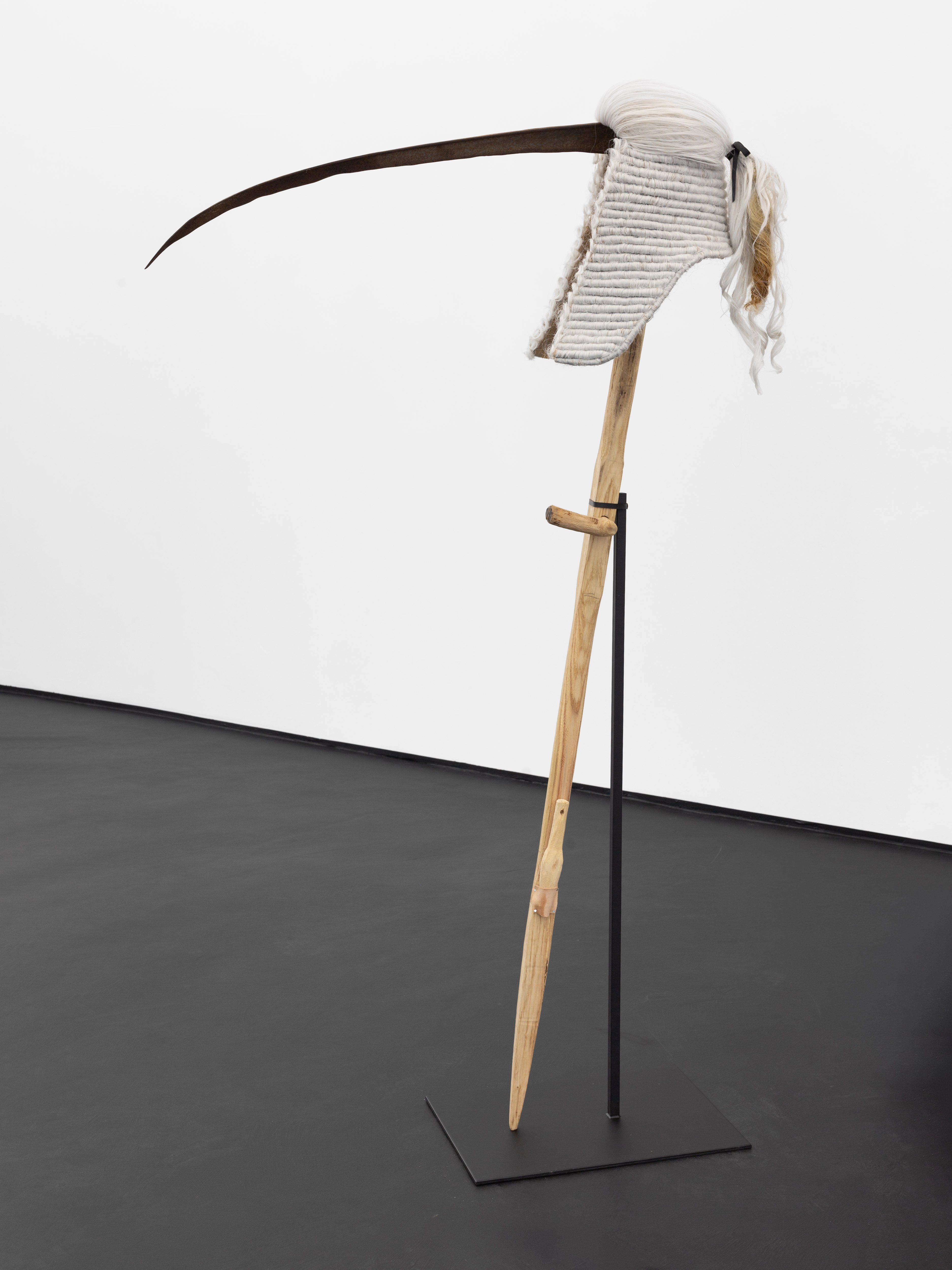
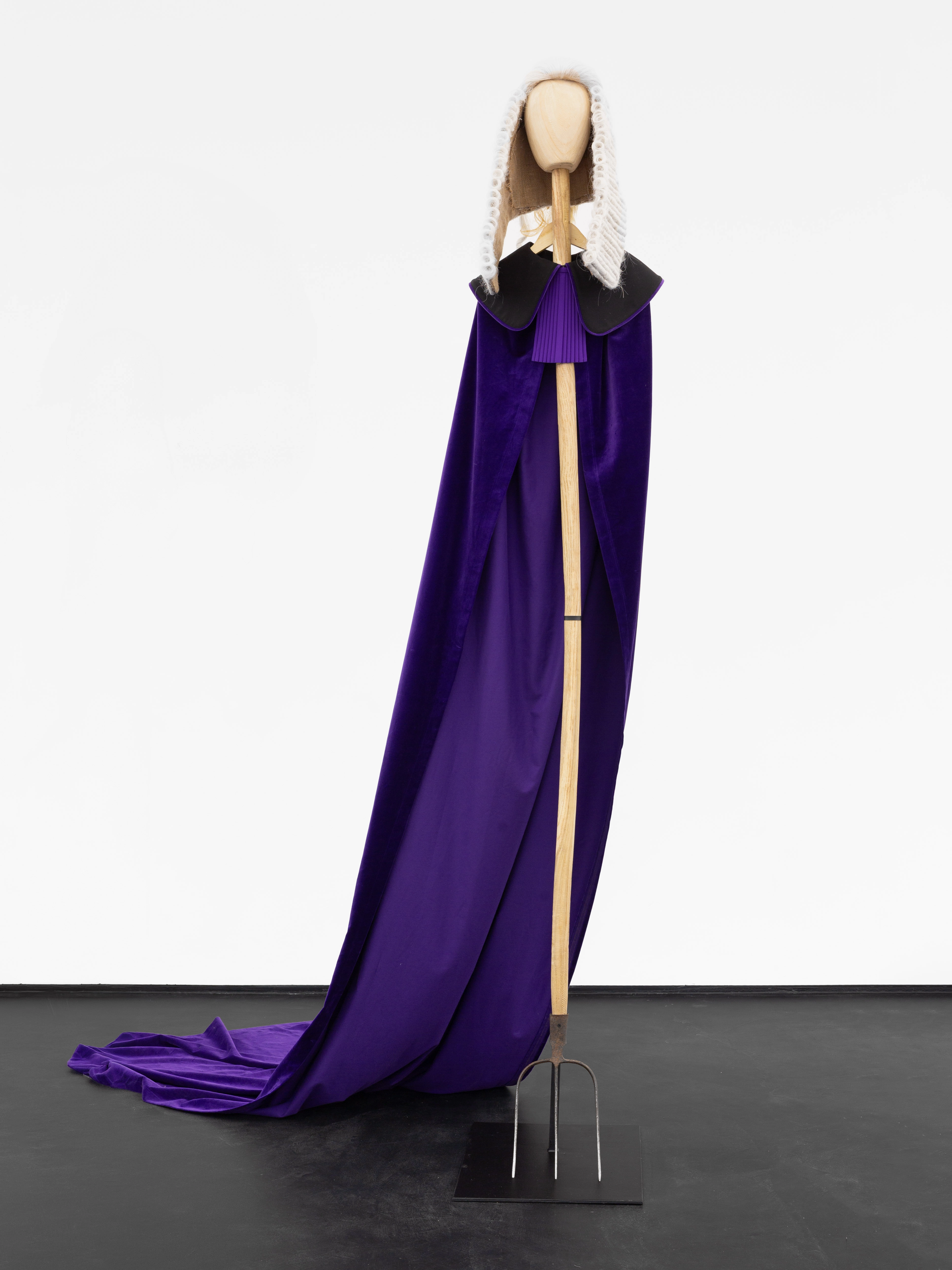
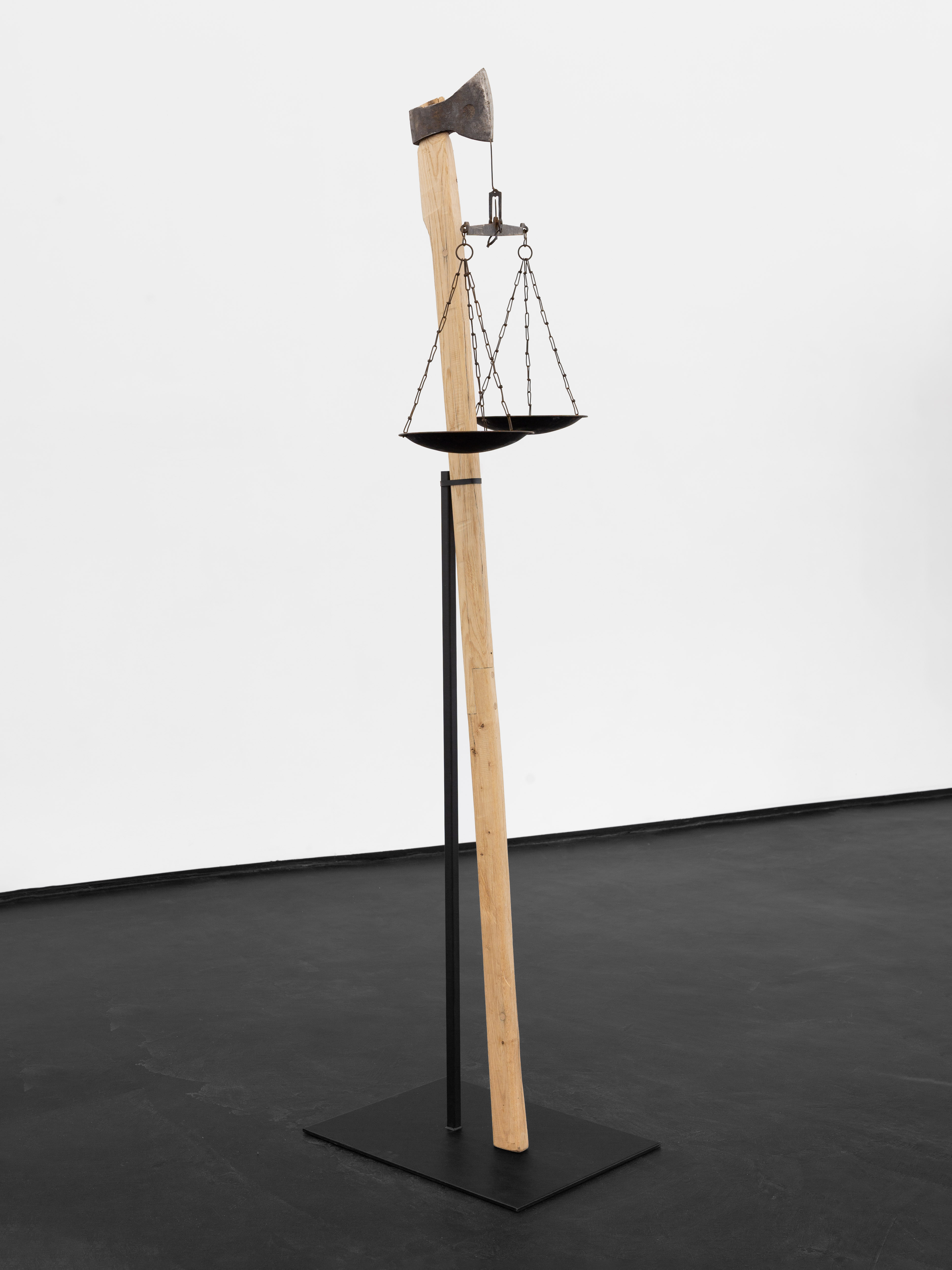
In Thieves of Conflict, conflict is taken away from people and absorbed by institutions. Instruments of revolt—scythes, pitchforks, and axes—become burdened with the symbols of law. Lived experience is transformed into legal code; conflict ceases to exist as a relation between people and becomes procedure instead. A similar mechanism appears in Polityka Passport Award, a project rooted in the artist’s own experience. Freedom here does not simply derive from rights, but from access to culture, status, and recognition. Not everyone possesses a “passport” that allows them to leave confinement, whether literal or symbolic.
Meanwhile, Tender Armor and Rags restore visibility to those reduced by the system to the role of inmates. Rycharski juxtaposes disappearing prison culture with the erasure of peasant culture. In the soft, crocheted armor, the myth of strength fractures, vulnerability replacing protection. In drawings made on prison rags, art becomes a means of reclaiming voice and subjectivity.
At the center of the exhibition remains the question: who is really the criminal? Banner of the Podlasie Janosik evokes the figure of the folk outlaw who broke the law in response to injustice. Crime here is not portrayed as an individual pathology, but as a response to a system that itself produces inequality. The law structures conflict and then punishes those who lack the strength or fluency to speak its language.
This logic is pushed even further in Casting for Judas, a performance in which participants speak about their own betrayals. Guilt ceases to appear exceptional. Instead, it emerges as something woven into social relations themselves. The icon accompanying the performance, Jesus carrying Judas, painted directly onto a criminal code, does not abolish the law, but exposes its limits. The law knows how to punish. It does not know how to carry the full weight of a human being.
Wolf’s Hole operates like a factory of guilt. You enter as a viewer. You leave understanding that the label “criminal” speaks not only about the individual, but above all about the system that assigns it.
This is not an exhibition about “them.”
It is an exhibition about you.
– Taras Gembik
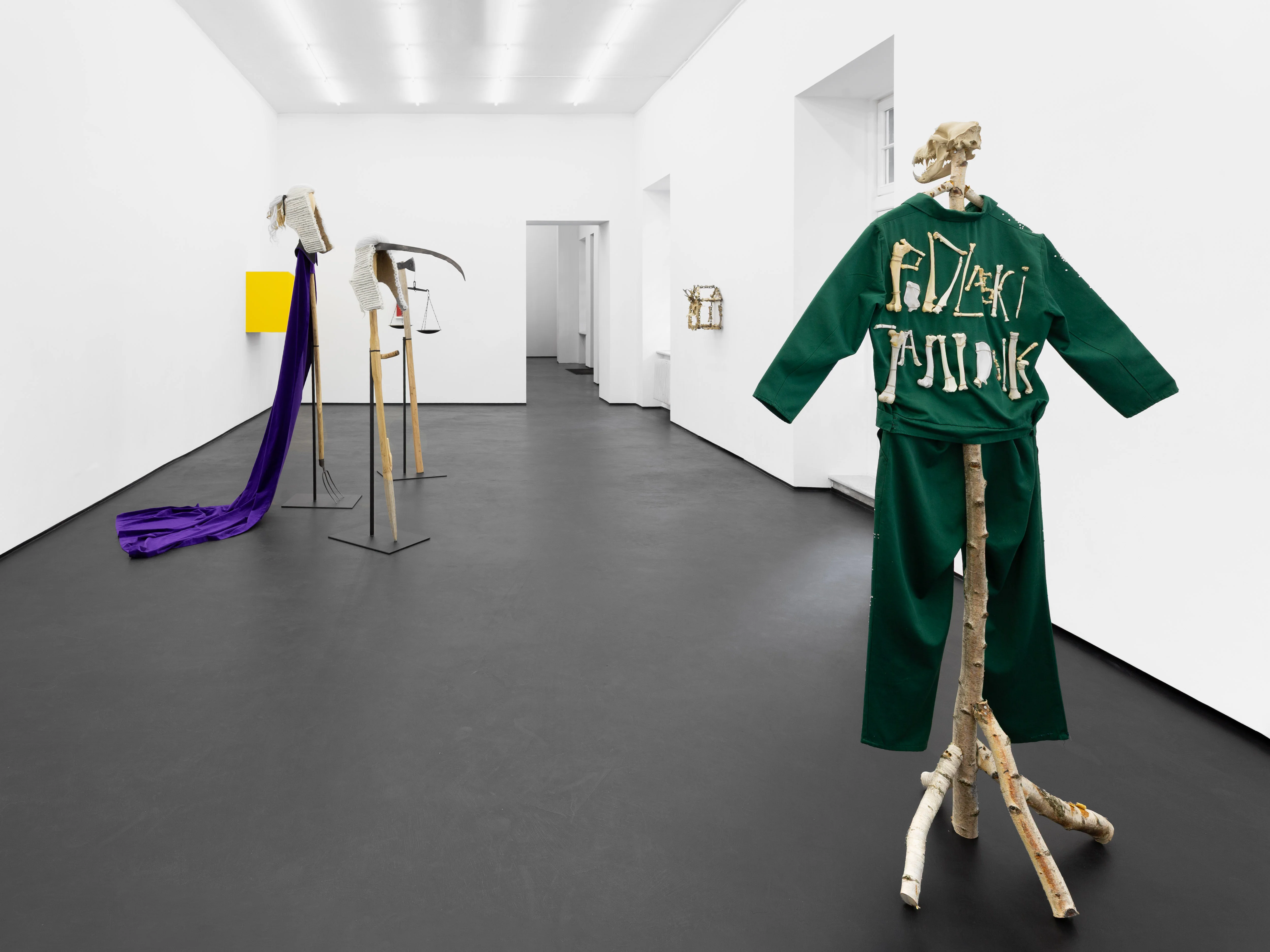
The work refers to the concept of the “five-minute prison” developed by Lech Falandysz within the framework of Radical Criminology, inspired by Nils Christie’s reflections on a society without penal institutions. Falandysz proposed separating punishment from the prolonged infliction of suffering and reducing it to a brief, symbolic act: a public check-in that recalls responsibility. Punishment would become a ritual closure of social conflict, closer to a funeral ceremony than to a mechanism of repression.
Placed on the gallery facade, the Five-Minute Prison sign, styled after official prison signage and bearing the state emblem, operates as a quasi-institution. It stops passersby, produces disorientation, and provokes questions about the boundary between a real institution and a symbolic mechanism of subordination.
On another level, the title develops a reflection on contemporary society as a producer of countless “micro-prisons” in everyday life: situations of forced submission to an indifferent clerk, an employer, a toxic relationship, or economic dependency. Punishment is no longer a separate institution; it disperses through daily life in the form of brief acts of subordination, in which the individual reports their helplessness before the system.
An important thread in the work is disappearing prison culture: its language, rituals, and unwritten codes of the Grypsera subculture. Placed alongside the artist’s earlier works on rural culture, it appears as another structure in decay, displaced by standardized institutional modernity. Yet it continues to produce its own language of resistance, much like peasant culture. Five-Minute Prison is also a proposal for thinking about punishment without revenge, responsibility without stigmatization, and power that does not need walls in order to operate effectively. Within the gallery, it becomes a space for confronting mechanisms of power and exclusion, and for reflecting on the penal system and the languages of survival developed by disappearing cultures.
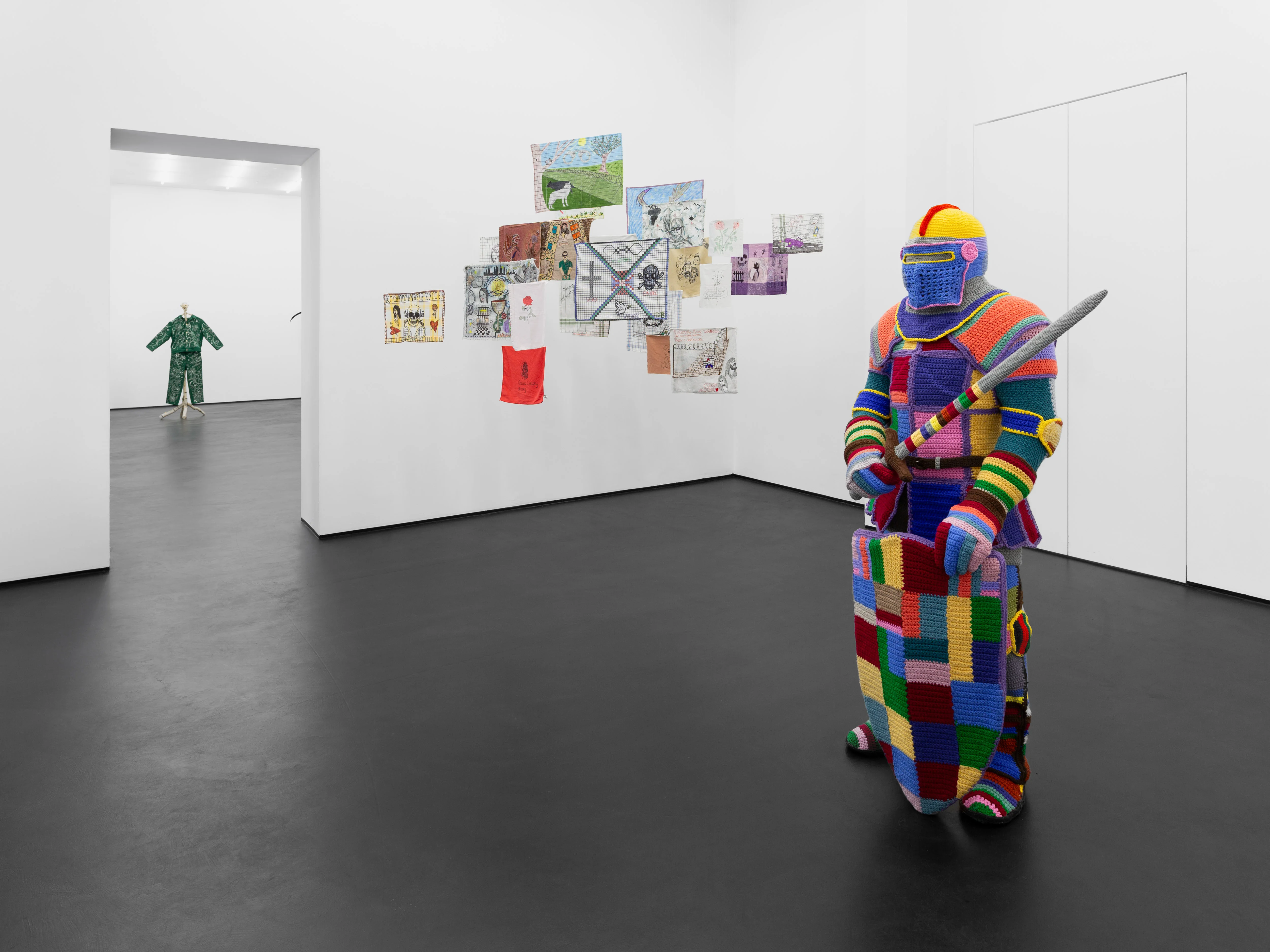
Tender Armor is a full-scale suit of armor handmade in crochet from thick, colorful yarn. The helmet, breastplate, shoulder guards, gloves, and leg protection faithfully recreate the elements of historical armor in a soft, pliable material.
The armor was created through the collaboration of two groups: incarcerated individuals and women from rural housewives’ associations. Fragments made in prison meet fragments made in the countryside. Two worlds are joined by one weave. Both cultures—prison and rural—are disappearing formations, dissolving under the pressure of institutional standardization. Both developed their own languages, rituals, and communal forms of labor, which are gradually losing their carriers. Their connection in one object becomes an act of preservation: crochet belongs to the rural world, while part of the project emerges from the world of prison.
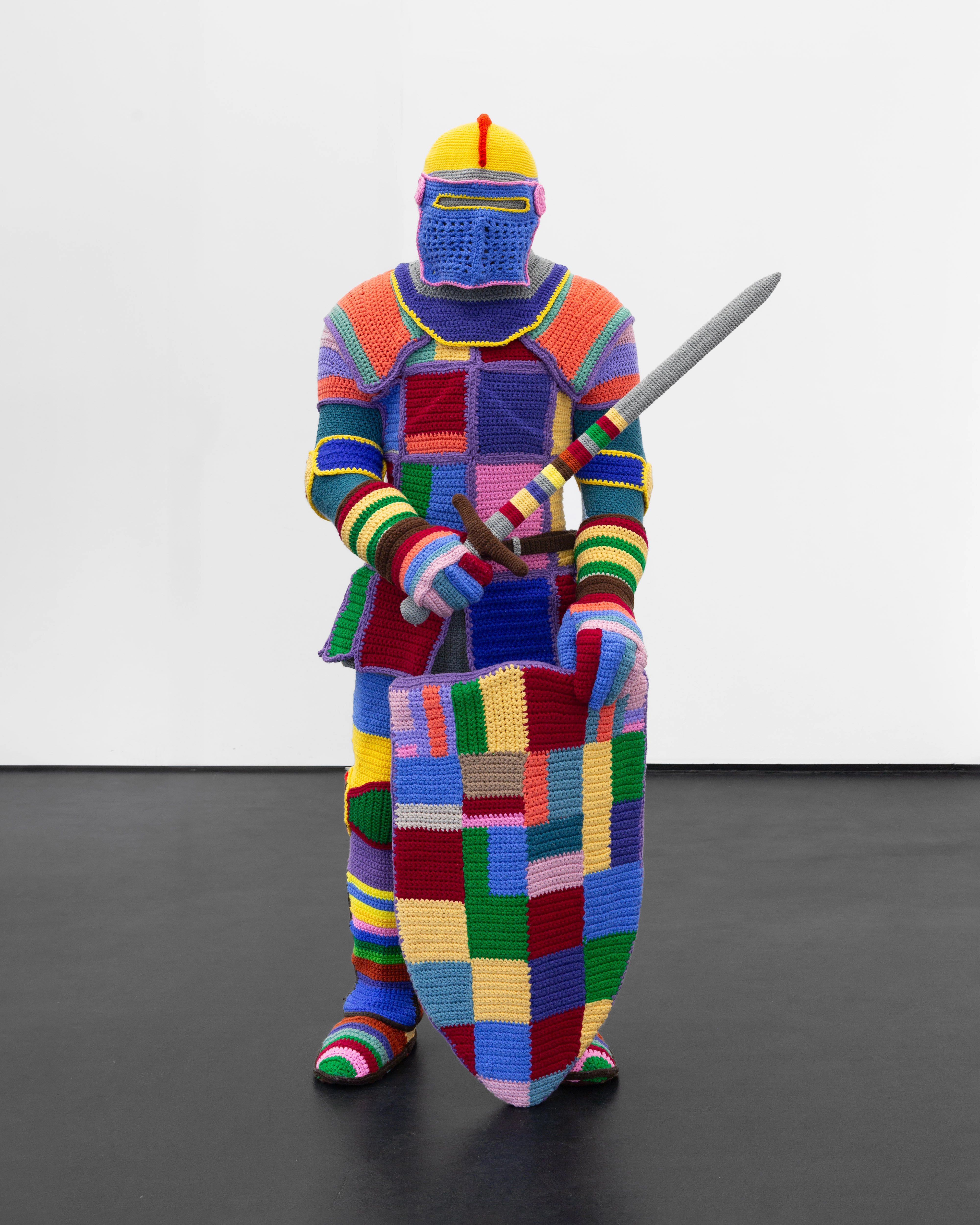
The work points to the paradoxes of life inside an institution of isolation. In prison, masculinity takes the form of hard armor: emotional control, a mask of strength, constant readiness for defense. The knight’s armor visualizes this imposed role. Yet constructing it from soft yarn reverses the logic of protection: the armor reveals the fragility of the body. Instead of distance, it proposes closeness; instead of hardness, tenderness. The object is full of tensions: masculine in symbolism, yet made with a technique traditionally associated with women; monumental and at the same time delicate; historical in form, but contemporary in meaning.
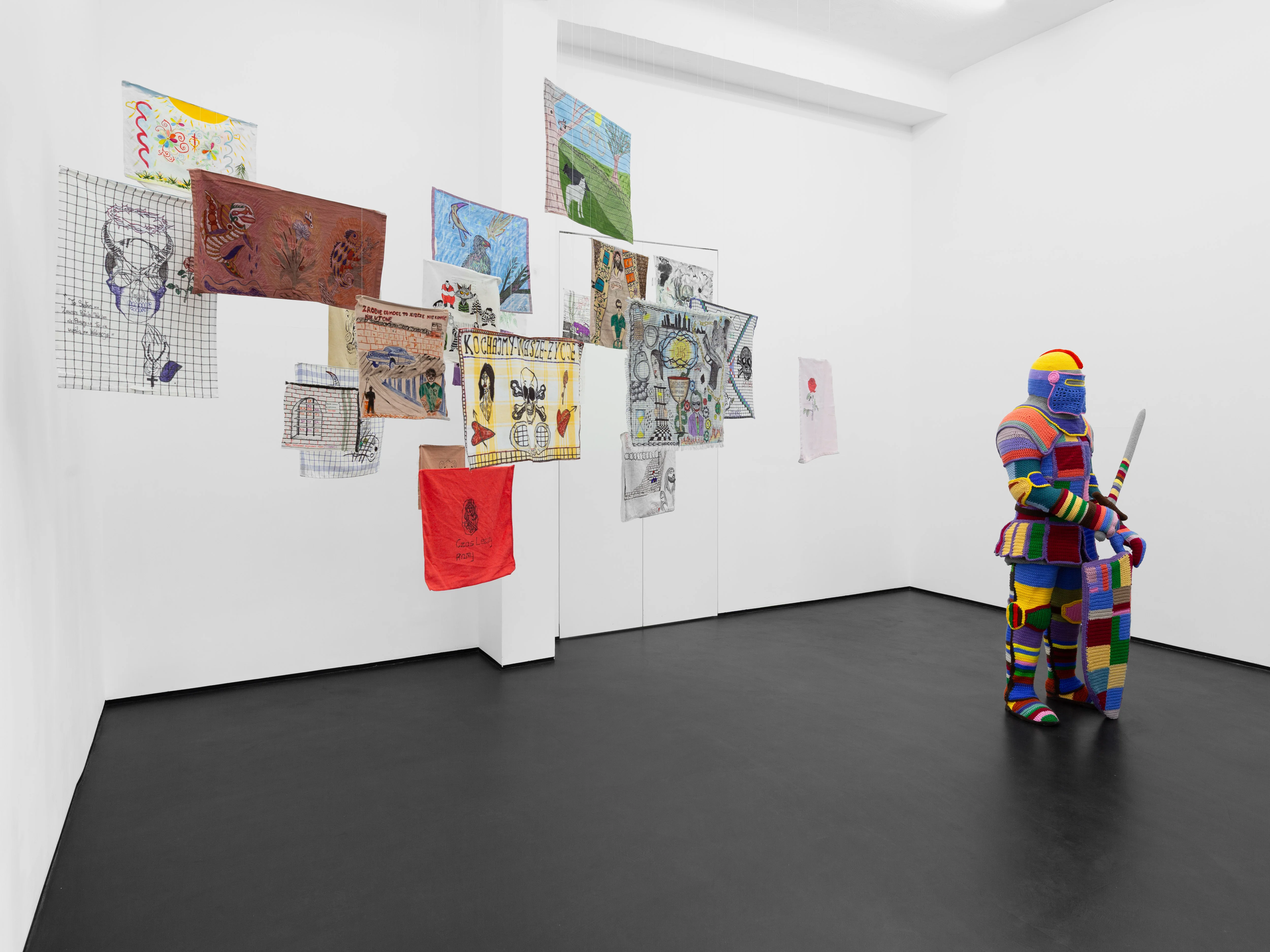
The series presents objects created by incarcerated individuals from Warsaw prisons in collaboration with Daniel Rycharski. Made during workshops, they consist of ink drawings on prison rags, inspired by Mexican American artepaño. This form of prison art uses illustrated textiles, usually drawn with ballpoint pen, which function as visual diaries, gifts for loved ones, and at times even as currency.
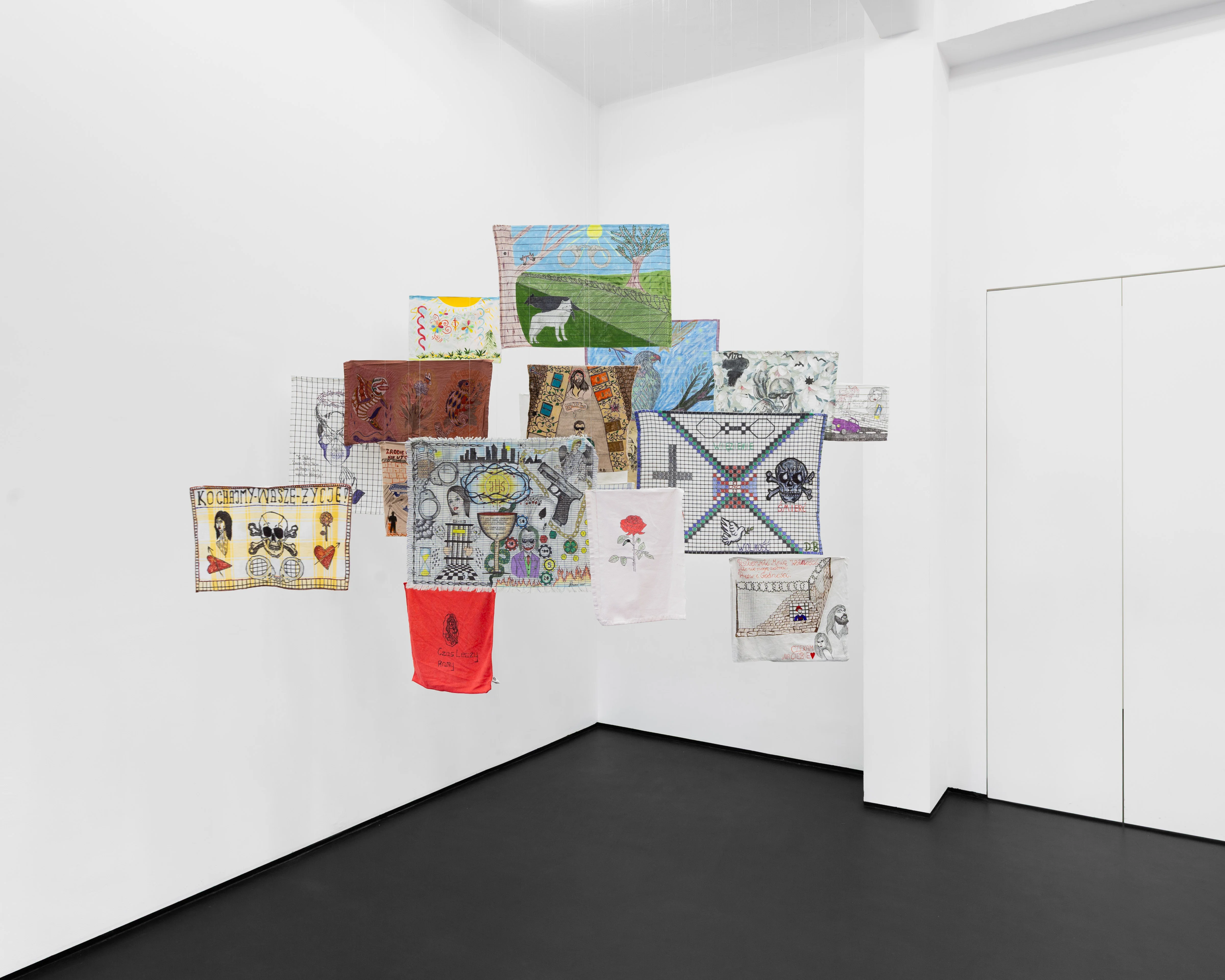
The works refer to Catholic motifs present in artepaño, continuing the tradition of extracting ink from the pages of the Bible, here using saliva. In the New Testament, the story of healing centers on God mixing saliva with earth and applying the resulting mud to the eyes of a blind man, restoring his sight. In these works, ink becomes a metaphorical earth, and once mixed with saliva and applied to the rags, it reveals the hidden stories of incarcerated individuals, while also healing society of its blindness to their humanity. Boundaries are crossed: through their stories entering social consciousness, prisoners metaphorically leave the walls of the institution.
The works made by Warsaw inmates, rich in symbolism, combine comic and dramatic registers, while pain and mortal seriousness mingle with absurdity. The motifs used, from flowers and a teddy bear to depictions of Jesus on the cross, reveal individual sensitivities, experiences, and positions.
Two peasants argued over land. The case dragged on until it remained stuck in court for nearly twenty years. When the lawyer’s son, after he had finished his studies, received the same case, he resolved it in three months. His father commented: “You fool. I kept it going for twenty years so that you could finish your studies.” In this story, heard by the artist, conflict was taken away from people and turned into procedure. It ceased to be a conversation and became fuel for the career and prestige of the upper class.
The artist sees a similar mechanism of “conflict theft” today in public space. Specialists, mediators, and officials take over disputes that once had communal meaning: they taught negotiation, responsibility, and the setting of boundaries.
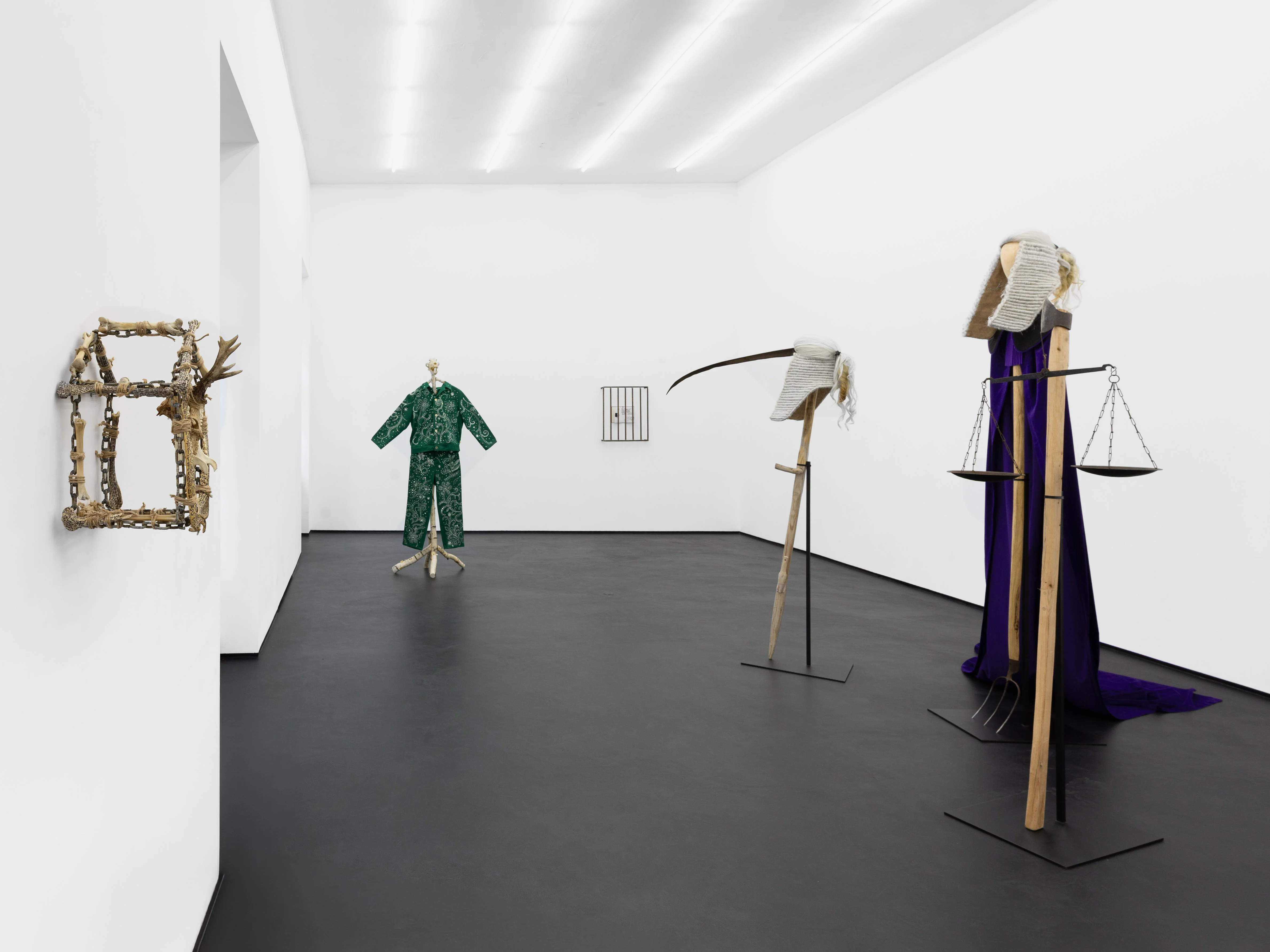
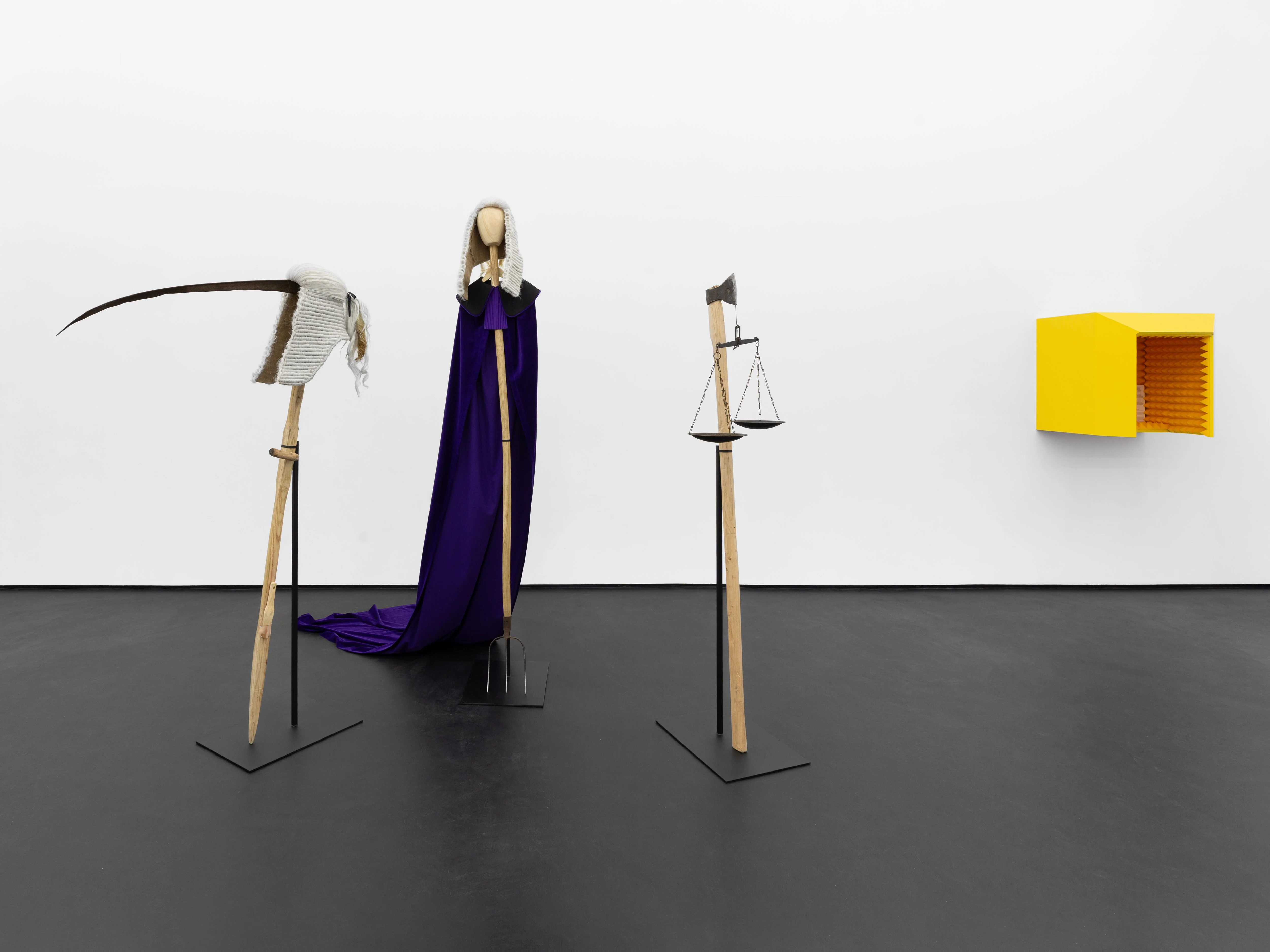
The installation consists of three objects, authentic tools that could be used for fighting, but are taken over by the system. The scythe is dressed in a judge’s wig, while the pitchfork wears a jabot and robe. The axe serves as a stand for the scales of Themis. The wigs were handmade from cow tail hair from the area around Kurówko by the artist and his mother. Tools of labor and revolt become mere hangers for symbols. The artist refers here to a scene from Reymont’s The Peasants: the village goes with pitchforks, axes, and scythes to fight for the forest. It wins, but the landowner activates criminal law, the police arrive, peasants are sent to prison, and the village falls into debt. Law completes what the guns of the manor’s gamekeepers failed to do.
Another thread is the penetration of this mechanism of “conflict theft” into cultural institutions, visible in a play on words: the term curator derives from judicial and legal terminology. The contemporary art institution takes on the role of an organ of law, removing the artist from the real field of struggle and placing them in the safe space of the gallery. In return, it claims the right to supervise meanings and uses them as raw material for its own prestige.
The work reverses the hierarchy: those who are meant to guard justice and freedom become its “scarecrows”. In this sense, the work continues the line of thought developed in Scarecrows (2018–2019). In this version of the installation, the scarecrows take the form of legal and art professionals, figures of fear whose presence signals that the matter has been definitively taken out of people’s hands.
Wolves appeared in Kurówko. Near his home, the artist found the body of a torn-apart deer. From these bones, a shrine was built, around which the work concentrates its reflection on institutional violence that has received neither judgment nor a ritual recognition of harm.
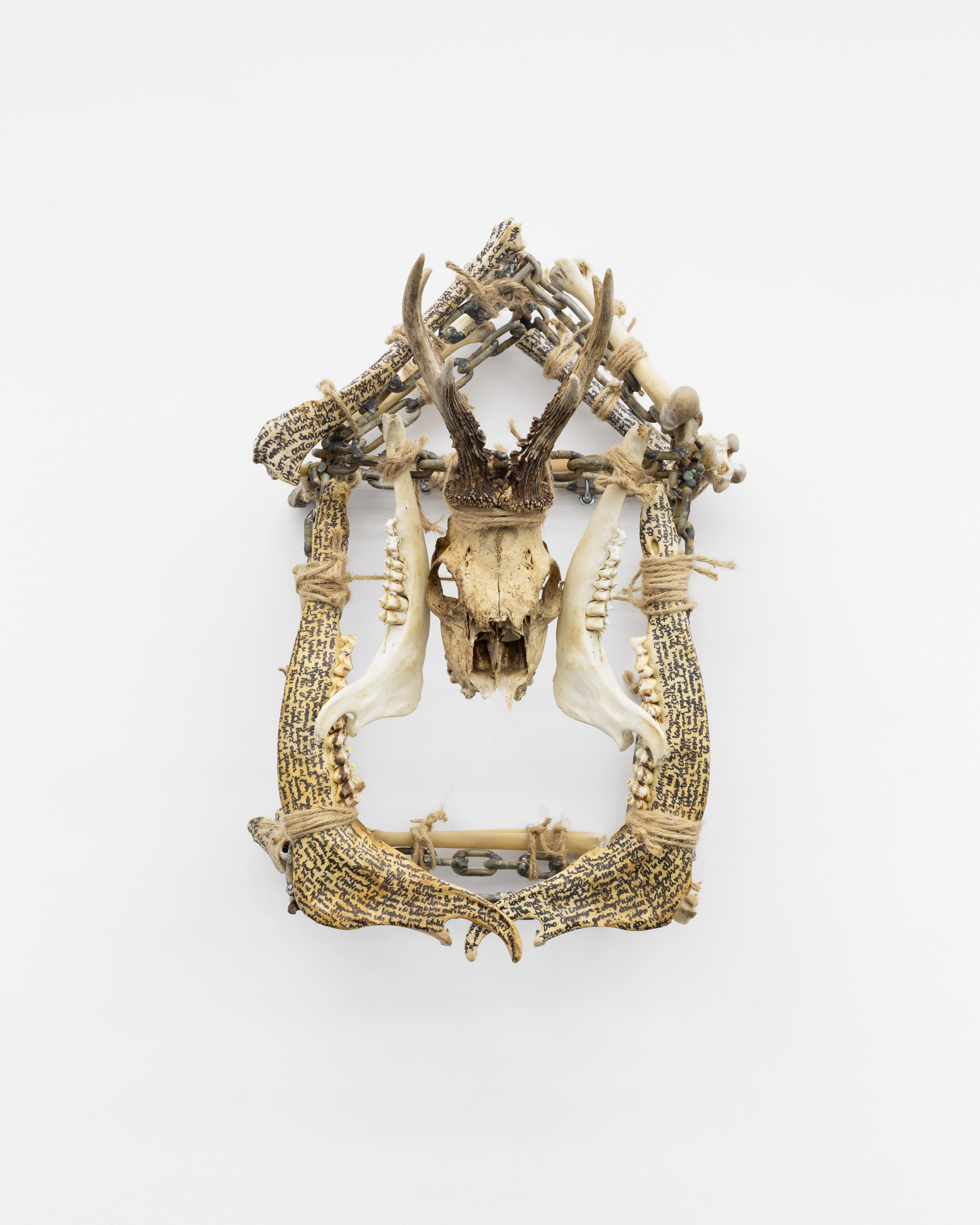
The work refers to the story of a former priest who sexually exploited the artist without breaking criminal law, since Rycharski was already legally an adult. This tension between formal legality and the real experience of harm forms one of the key fields of the work: violence remains invisible to the law, but it does not cease to be violence. Fragments of prayer engraved on the bones reveal the ambiguity of the titular declaration. The words “you are mine” sound like an expression of care, but also like a formula of possession: the language of a relationship in which an asymmetry of power is hidden beneath the mask of spiritual closeness.
Lech Falandysz proposed bringing punishment closer to a ritual of mourning: instead of stigmatizing the perpetrator, creating a situation of public recognition of guilt and symbolic closure of trauma. The absence of a legal violation means here the absence of procedure, and the absence of such closure for the person harmed, who has no possibility of mourning lost trust, innocence, or faith. The work becomes an attempt to create a ritual recognizing violence that escapes legal categories. A ritual that never took place in reality: a ceremony without a priest, a liturgy reclaimed by the one from whom liturgy was taken. It creates a missing rite: quiet, intimate, inscribed in the rural landscape, suspended between the sacred and the profane.
You Are Mine asks about justice in the face of violence that can neither be repaired nor clearly named as a crime. It shows that the practice of recognizing suffering is necessary not only in the penal system, but also in institutions that built their power on moral authority.
In Radical Criminology, Lech Falandysz writes about the criminal as “a kind of Robin Hood,” an individual rebelling against the limitations imposed by their class position in society. In this context, the law does not stand above conflict; it organizes it, while prison, instead of reducing social tensions, merely stores them.
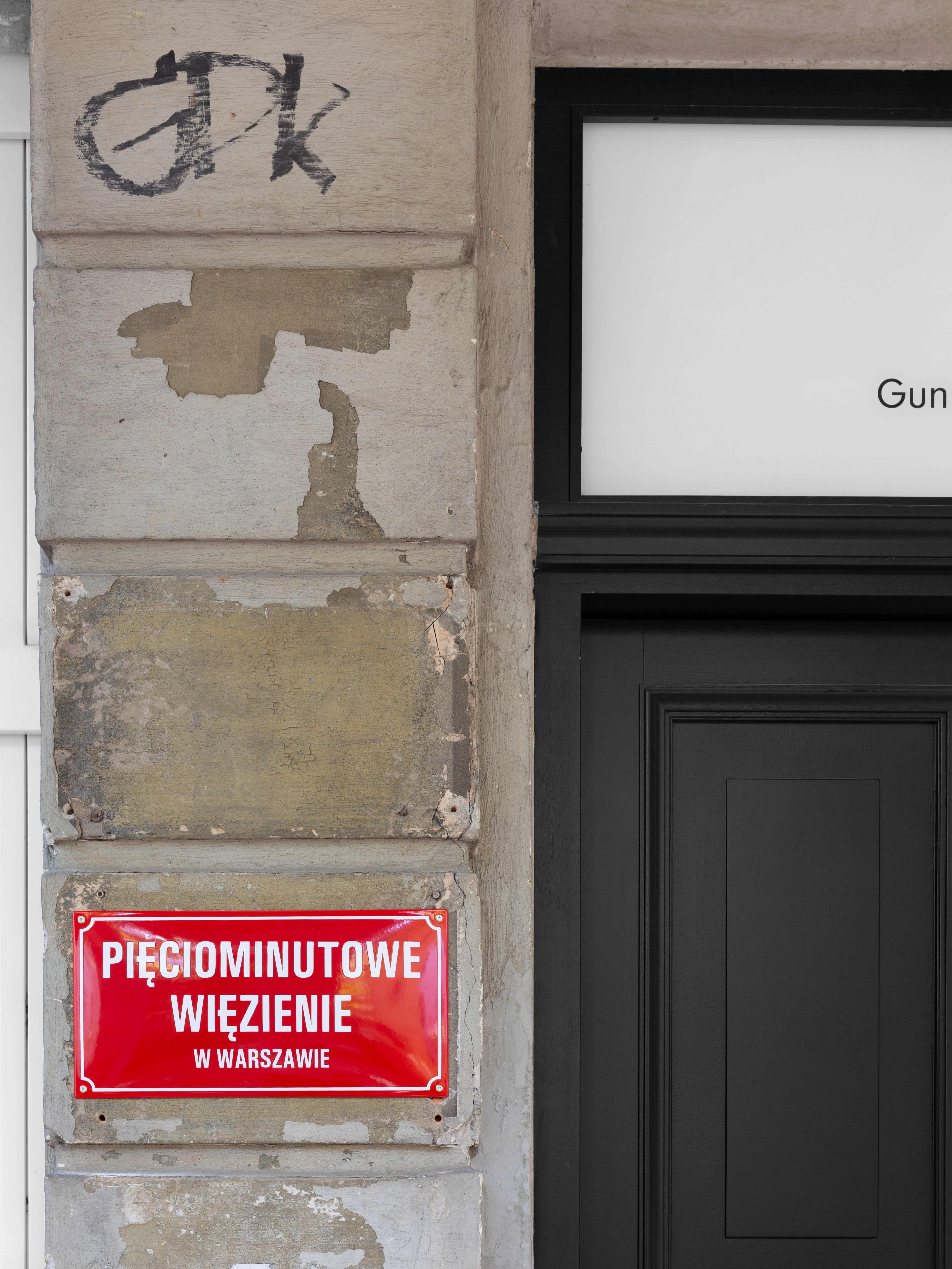
The work materializes these ideas. An authentic prison uniform from the Warsaw-Białołęka Detention Center was transformed into a banner for Józef Korycki, the legendary Podlasie Janosik. Korycki operated in postwar villages of Podlasie, robbing institutions of communist power and redistributing the goods among the poorest peasants, for whom the system’s promised equality meant, in practice, continued exclusion.
The prison uniform, a sign of institutional control, becomes the carrier of another symbolism. On the one hand, the banner was covered by the artist and incarcerated collaborators with thousands of rhinestones. At the same time, the uniform’s buttons were replaced with one-euro coins. In Polish prisons, around four złoty per day is allocated for feeding one inmate. The coin becomes a button, money, and a sign of scarcity at once. The inscriptions on the banner are arranged from animal bones. Bone—what remains after everything valuable has been removed—here becomes an alphabet of poverty and a literal record of insufficient prison food.
At the center of the composition is a wolf skull, referring both to the exhibition title Wolf’s Hole and to the figure of Korycki. In old English law, the term wolfshead referred to an outlaw who could be hunted like an animal. The wolf thus becomes a symbol of a person pushed outside the community and forced to fight for survival.
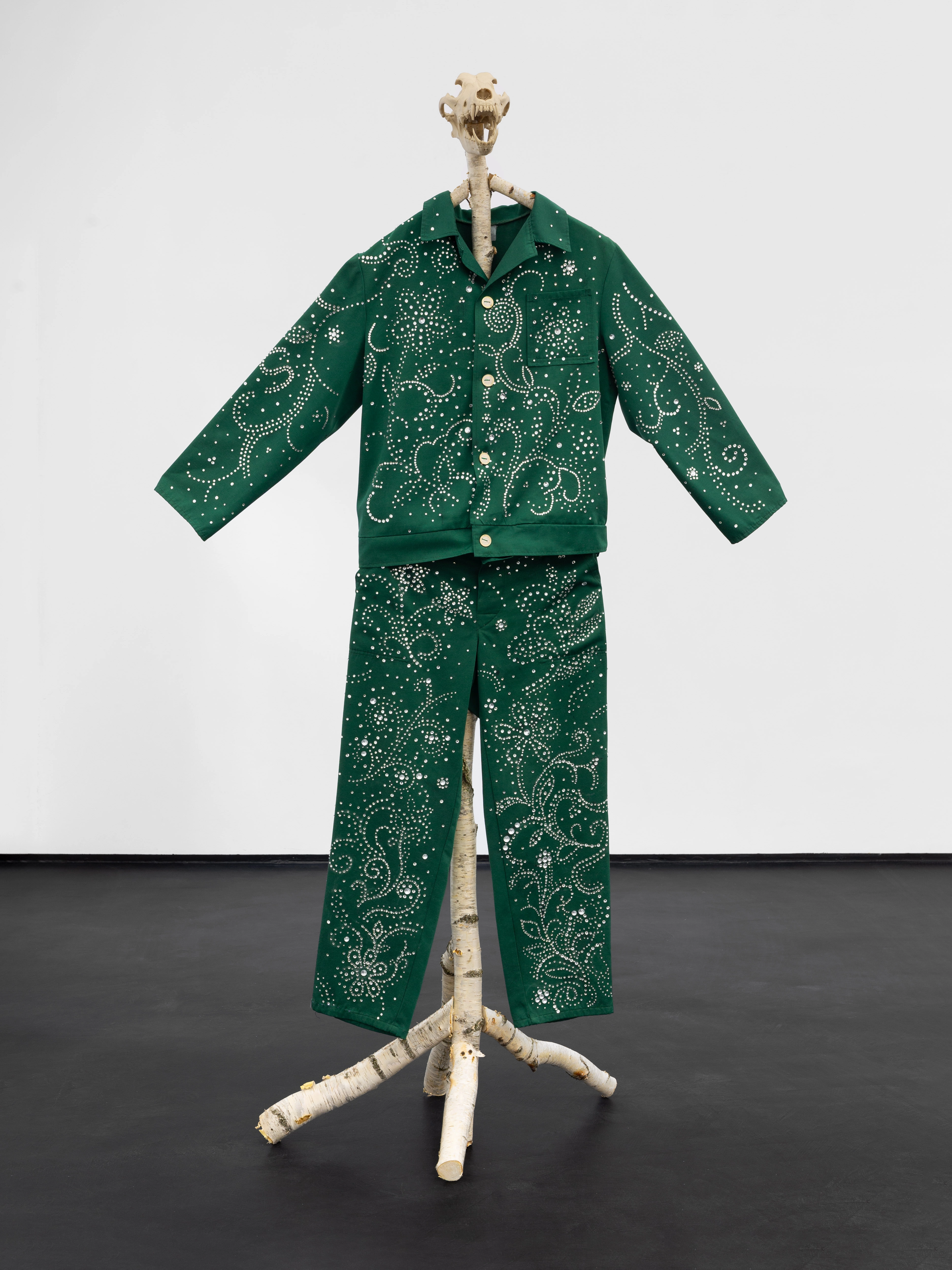
Seen through Falandysz’s thought, crime is not an individual pathology, but a response to structural inequality. The banner does not represent any national or institutional community, but the structure of conflict: rebellion inscribed into the system, the criminal produced by the conditions that later punish him. It is not a tribute to a bandit. It is a question about who today is truly Robin Hood, and who establishes the law that turns the rebel into a criminal.
The point of departure for this work is the artist’s personal experience of staying in a locked psychiatric ward in Kraków. The artist could not leave the ward on his own and was released only after his mother intervened by showing his Polityka Passport Award, an annual cultural prize presented by the Polish weekly magazine Polityka. Conditions in the ward were violent: patients were pharmacologically sedated, the space was dehumanized, and the doctor-patient relationship was based on total dependency. After hearing this story, the lawyer Prof. Monika Płatek commented: “Well, you see, you were lucky. Not everyone has a Polityka Passport.”
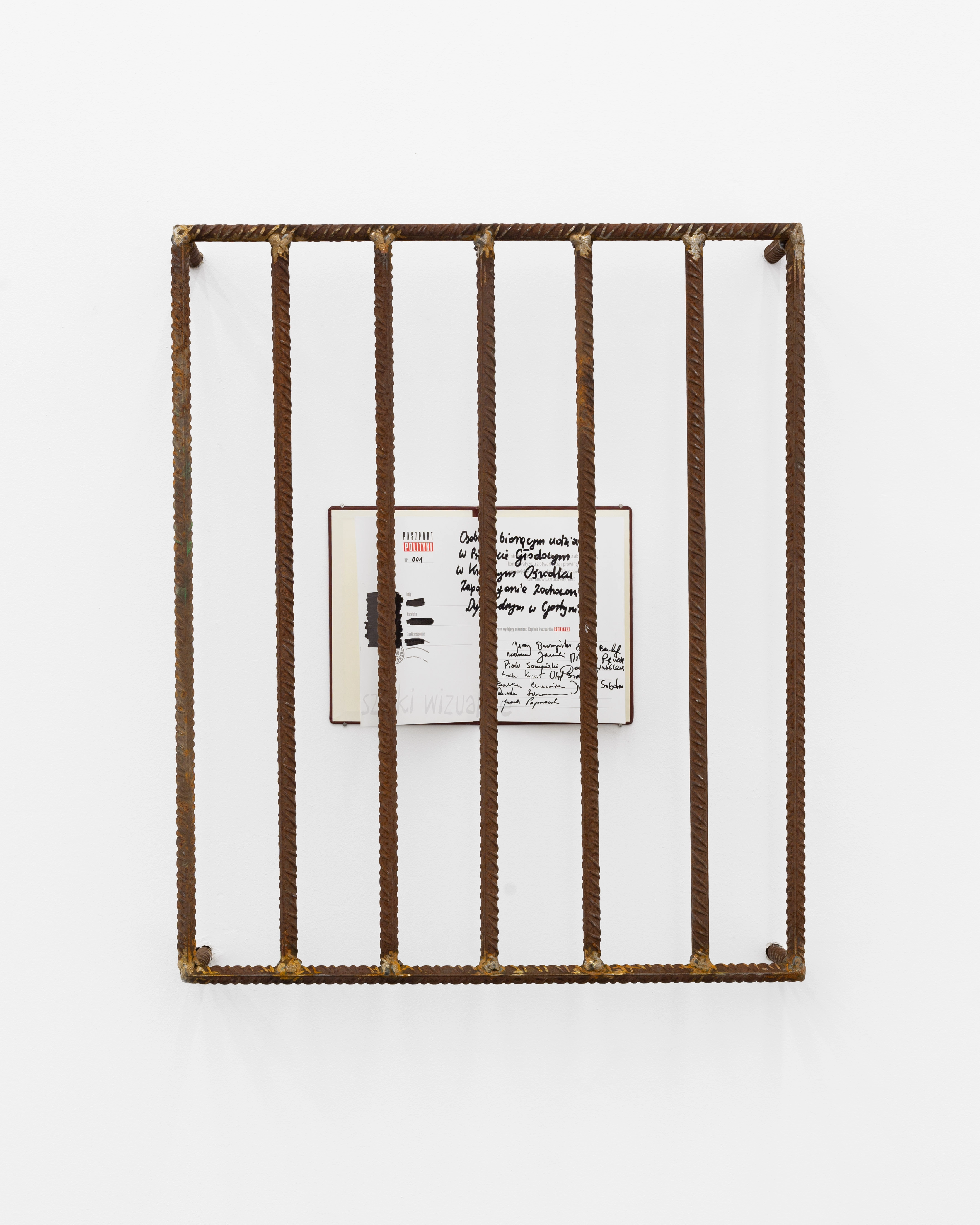
The work points to the situation of people functioning outside meaningful social and legal protection. Its broader context is the National Center for the Prevention of Dissocial Behavior in Gostynin, where individuals who have completed prison sentences may still be held indefinitely without committing a new crime. In 2025, patients at the center began a hunger strike and wrote letters to the Minister of Health and the Patient Rights Ombudsman. In one statement, they wrote: “We are not beasts or threats. We are people, citizens, patients.”
At the center of the work is the artist’s original Polityka Passport Award. Rycharski erased his own name from the document, symbolically transferring it to the participants of the hunger strike in Gostynin. The passport is covered by a metal grate. It has no legal authority, yet in practice it became a document capable of granting credibility, protection, and institutional recognition. The artist asks whether freedom within closed institutions is determined by medical and legal procedures, or rather by access to symbolic signs of prestige, culture, and social position.
Within the context of the exhibition, the work expands the notion of the total institution, revealing how systems organized around care can simultaneously deprive individuals of dignity and agency. Here, the award, originally intended to recognize cultural achievement, is repurposed as a passport, a fragile instrument of visibility and recognition for those pushed beyond the limits of the social and legal order.
Casting for Judas is a performative work in which the public is invited to speak about their own betrayals, small and large, personal and systemic. This gesture serves neither confession nor purification, but reveals the universality of guilt. Betrayal is not assigned to an individual; it is shown as a shared experience, inscribed in social, institutional, and economic relations.
The performance is accompanied by a painting: a small icon depicting an apocryphal fifteenth station of the Cross, Jesus carrying the body of Judas on his back like a sheep. This station, absent from official Christian tradition, appears only in folk and marginal stories, outside doctrine.
Judas is not absolved, acquitted, or cleansed. He is lifted and carried despite his guilt. This gesture signifies a mercy that does not close conflict with a sentence. The icon was made jointly by the artist and incarcerated collaborators using a stencil, directly on the Polish Penal Code, creating a provisional “Non-Penal Code.”
The context is the real Non-Penal Code proposed by Herman Goldschmidt for Greenland in the 1950s. Based on local tradition, the system rejected prisons and the logic of retaliation: conflict was not the property of the state, and the response to guilt lay in repairing broken relationships, not in isolating the perpetrator. The artist transfers this idea onto the Polish Penal Code, not destroying or invalidating it, but overwriting it: showing the limit that law cannot cross.
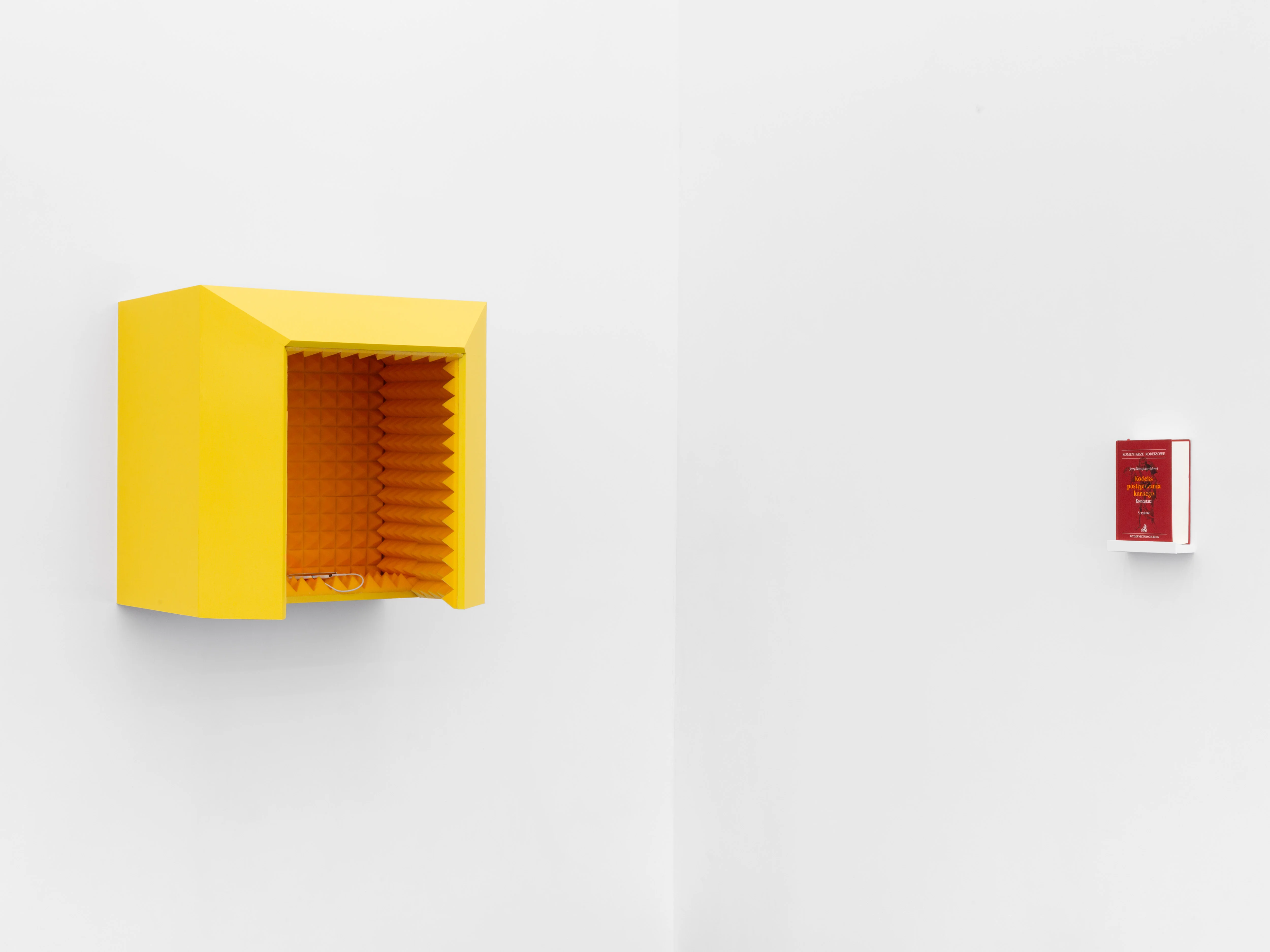
The project closes the entire exhibition. Addressing total institutions that not only create mechanisms of subordination, labeling, and exclusion, but also claim the right to manage guilt, punishment, and salvation, the artist points to the possibility of reclaiming community. One based on the readiness to carry another person. He shifts the question of betrayal from individual morality to the level of the system, asking who truly betrays: the individual, or the institution that forces betrayal as a condition of survival.